AI-first food app
Cooking is easy. Getting to cook is the hard part. The feature decision and the research was my major contribution.
Role- UX Designer (Final Year Project)
Breakfree Consulting Mumbai, India.
Project Timeline 2 weeks
I designed Platted an AI-first food app that bridges the gap between knowing what to eat and actually being able to eat it, without switching between three different apps to do so.
I designed Platted an AI-first food app that bridges the gap between knowing what to eat and actually being able to eat it, without switching between three different apps to do so.
01 Efficiency, not laziness. Users aren't unwilling , they're overwhelmed. The highest drop-off happens between planning and executing, not between wanting and planning.
Research · Sprint 1, Days 2–5
02 Fridge-first thinking. "What can I cook with what I have?" is the most common real-world question. No app in the competitive set answered it.
03 Budget stress is emotional. Spending on food causes genuine guilt, especially for students. Healthy eating felt like a luxury, not a default.
04 Morning vs evening decisions. Participants made 4× better food choices in the morning. The interface had to work for evening-brain, not just ideal-state-brain.
People aren't lazy.
The system makes it hard.
During interviews, I kept hearing the same loop: I want to eat better, I planned to cook, but the effort to get from intention to plate is exhausting.
Fragmented experience :- Users juggle a recipe app, a grocery app, and a delivery app — none of them talk to each other.
3+ hours/week lost :- Busy professionals spend Sunday afternoons planning, ordering, and prepping — before cooking even starts.
Budget vs. nutrition impossible trade-off :- Students want to eat well but can't find ₹50/meal options that are also healthy and easy.
30% of groceries wasted :- People over-order because they can't see what they already have. The fridge is full. The food goes bad.
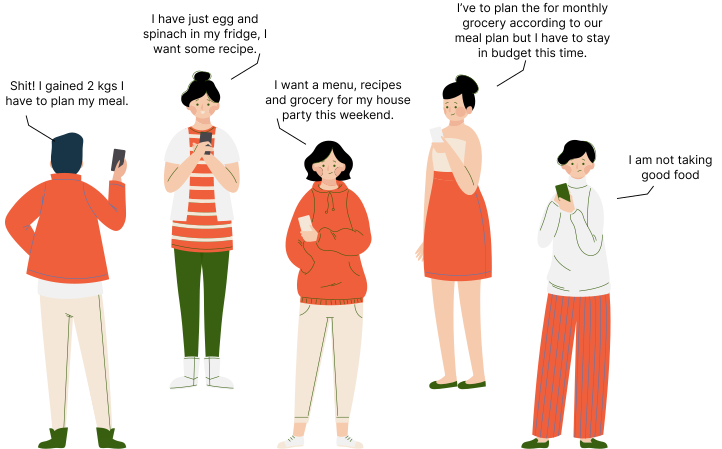
"It's month-end. I have eggs, curd, and bread in the fridge. I have no idea what to cook." — Interview participant, working professional, Pune
"I have a meal plan but searching and ordering all those ingredients one by one takes the entire Sunday." — Interview participant, college student
What about Zomato doing recipes now?
Zomato added recipes in 2024 — but it is a delivery app adding a feature, not a food-decision system. It still doesn't know what's in your fridge, your budget this week, or your allergy profile. Platted was designed around what you already have, not upselling you toward a restaurant order.
What I found when I stopped assuming
I ran 6 depth interviews and an affinity mapping session across two personas — working professionals and college students. The finding that surprised me most: people know what they should eat. They just can't execute on it.
People aren't lazy.
The system makes it hard.
During interviews, I kept hearing the same loop: I want to eat better, I planned to cook, but the effort to get from intention to plate is exhausting.
Fragmented experience :- Users juggle a recipe app, a grocery app, and a delivery app — none of them talk to each other.
3+ hours/week lost :- Busy professionals spend Sunday afternoons planning, ordering, and prepping — before cooking even starts.
Budget vs. nutrition impossible trade-off :- Students want to eat well but can't find ₹50/meal options that are also healthy and easy.
30% of groceries wasted :- People over-order because they can't see what they already have. The fridge is full. The food goes bad.
01 Efficiency, not laziness. Users aren't unwilling , they're overwhelmed. The highest drop-off happens between planning and executing, not between wanting and planning.
01 Efficiency, not laziness. Users aren't unwilling , they're overwhelmed. The highest drop-off happens between planning and executing, not between wanting and planning.
Research · Sprint 1, Days 2–5
Research · Sprint 1, Days 2–5
02 Fridge-first thinking. "What can I cook with what I have?" is the most common real-world question. No app in the competitive set answered it.
02 Fridge-first thinking. "What can I cook with what I have?" is the most common real-world question. No app in the competitive set answered it.
03 Budget stress is emotional. Spending on food causes genuine guilt, especially for students. Healthy eating felt like a luxury, not a default.
03 Budget stress is emotional. Spending on food causes genuine guilt, especially for students. Healthy eating felt like a luxury, not a default.
04 Morning vs evening decisions. Participants made 4× better food choices in the morning. The interface had to work for evening-brain, not just ideal-state-brain.
04 Morning vs evening decisions. Participants made 4× better food choices in the morning. The interface had to work for evening-brain, not just ideal-state-brain.
"It's month-end. I have eggs, curd, and bread in the fridge. I have no idea what to cook." — Interview participant, working professional, Pune
"I have a meal plan but searching and ordering all those ingredients one by one takes the entire Sunday." — Interview participant, college student
What about Zomato doing recipes now?
Zomato added recipes in 2024 — but it is a delivery app adding a feature, not a food-decision system. It still doesn't know what's in your fridge, your budget this week, or your allergy profile. Platted was designed around what you already have, not upselling you toward a restaurant order.
People aren't lazy.
The system makes it hard.
During interviews, I kept hearing the same loop: I want to eat better, I planned to cook, but the effort to get from intention to plate is exhausting.
Fragmented experience :- Users juggle a recipe app, a grocery app, and a delivery app — none of them talk to each other.
3+ hours/week lost :- Busy professionals spend Sunday afternoons planning, ordering, and prepping — before cooking even starts.
Budget vs. nutrition impossible trade-off :- Students want to eat well but can't find ₹50/meal options that are also healthy and easy.
30% of groceries wasted :- People over-order because they can't see what they already have. The fridge is full. The food goes bad.
"It's month-end. I have eggs, curd, and bread in the fridge. I have no idea what to cook." — Interview participant, working professional, Pune
"I have a meal plan but searching and ordering all those ingredients one by one takes the entire Sunday." — Interview participant, college student
What about Zomato doing recipes now?
Zomato added recipes in 2024 — but it is a delivery app adding a feature, not a food-decision system. It still doesn't know what's in your fridge, your budget this week, or your allergy profile. Platted was designed around what you already have, not upselling you toward a restaurant order.
What I found when I stopped assuming
I ran 6 depth interviews and an affinity mapping session across two personas — working professionals and college students. The finding that surprised me most: people know what they should eat. They just can't execute on it.
What I found when I stopped assuming
I ran 6 depth interviews and an affinity mapping session across two personas — working professionals and college students. The finding that surprised me most: people know what they should eat. They just can't execute on it.
Research · Sprint 1, Days 2–5
6 depth interviews, 4 key gap areas, 80% knew what healthy eating means & 100% failed to sustain it
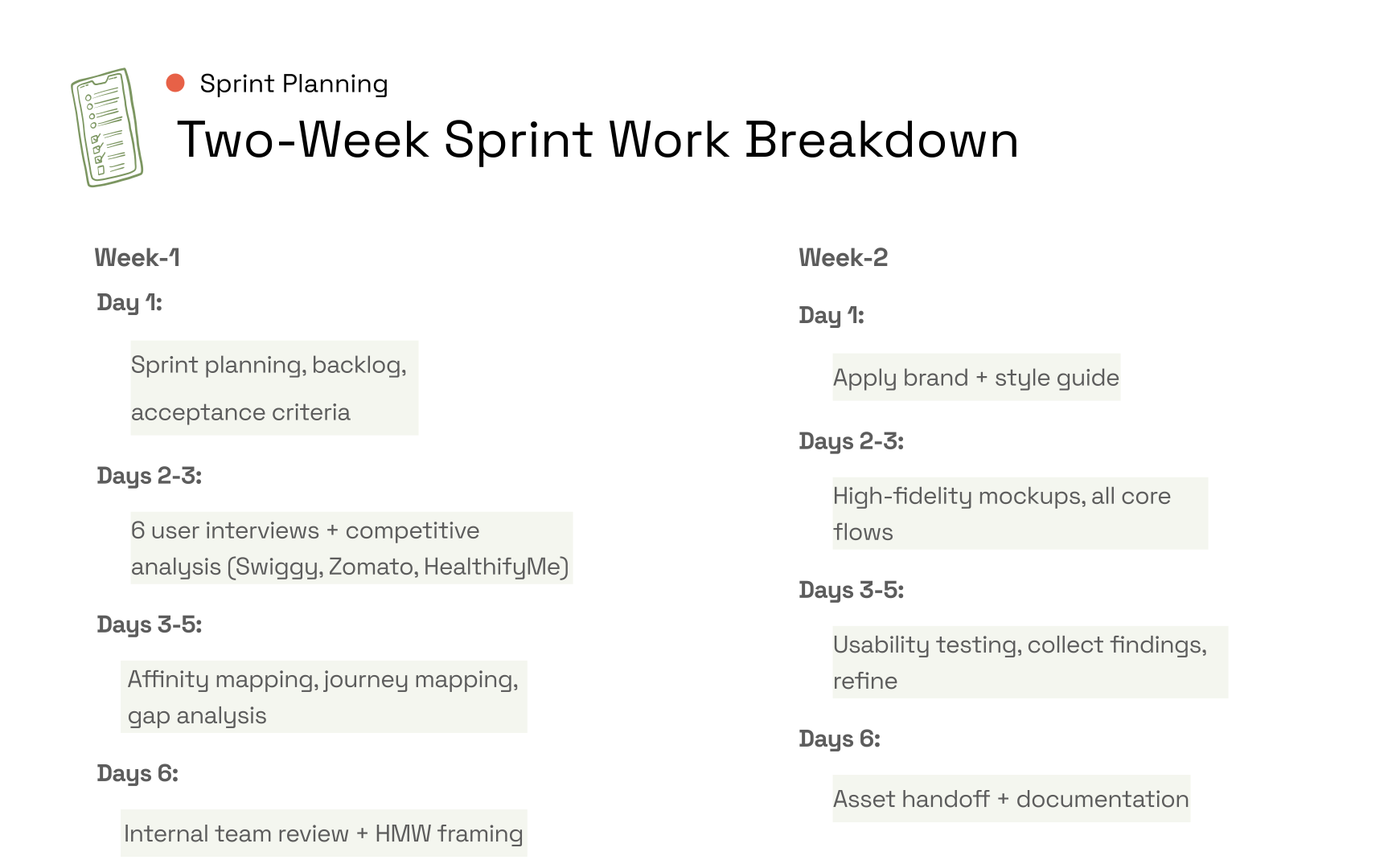
01 Efficiency, not laziness. Users aren't unwilling , they're overwhelmed. The highest drop-off happens between planning and executing, not between wanting and planning.
02 Fridge-first thinking. "What can I cook with what I have?" is the most common real-world question. No app in the competitive set answered it.
03 Budget stress is emotional. Spending on food causes genuine guilt, especially for students. Healthy eating felt like a luxury, not a default.
04 Morning vs evening decisions. Participants made 4× better food choices in the morning. The interface had to work for evening-brain, not just ideal-state-brain.
Research · Sprint 1, Days 2–5
6 depth interviews, 4 key gap areas, 80% knew what healthy eating means & 100% failed to sustain it
6 depth interviews, 4 key gap areas, 80% knew what healthy eating means & 100% failed to sustain it
01 Efficiency, not laziness. Users aren't unwilling , they're overwhelmed. The highest drop-off happens between planning and executing, not between wanting and planning.
02 Fridge-first thinking. "What can I cook with what I have?" is the most common real-world question. No app in the competitive set answered it.
03 Budget stress is emotional. Spending on food causes genuine guilt, especially for students. Healthy eating felt like a luxury, not a default.
04 Morning vs evening decisions. Participants made 4× better food choices in the morning. The interface had to work for evening-brain, not just ideal-state-brain.

What I chose, what I rejected,
and why.
These aren't the only decisions they're the three where the wrong call would have made the product meaningless.
What I chose, what I rejected,
and why.
These aren't the only decisions they're the three where the wrong call would have made the product meaningless.
What I chose, what I rejected,
and why.
These aren't the only decisions they're the three where the wrong call would have made the product meaningless.
01
Why I built a fridge scanner instead of a recipe search bar.
A recipe search bar assumes you already know what you want to cook. My research showed users most often don't. The real moment of need is: "I have eggs, curd, and bread — now what?" A search bar is useless for that moment. A fridge scanner — where you photograph or manually list what's left — lets the app generate recipes from real constraints, not ideal-state ingredient lists.
Trade-off I accepted: Longer onboarding (2 extra screens). I reduced the exit risk by making the screens feel like personalisation, not a form.
01
Why I built a fridge scanner instead of a recipe search bar.
A recipe search bar assumes you already know what you want to cook. My research showed users most often don't. The real moment of need is: "I have eggs, curd, and bread — now what?" A search bar is useless for that moment. A fridge scanner — where you photograph or manually list what's left — lets the app generate recipes from real constraints, not ideal-state ingredient lists.
Trade-off I accepted: Longer onboarding (2 extra screens). I reduced the exit risk by making the screens feel like personalisation, not a form.
Options considered
Rejected
Generic recipe search bar — type a dish name, see results. Fast to build, familiar pattern.
Chosen
Fridge scanner — photo or manual entry of what you have. App generates recipes from real inventory.
02
Why budget preferences live in onboarding, not settings.
My first instinct was to put budget as a filter — a settings page a user could optionally configure. But in testing I found that users who never set a budget filter got meal recommendations they couldn't afford, and they assumed the app wasn't for them. Moving budget into onboarding (cost per meal, meals per day, preference by meal type) made every recommendation contextually appropriate from session one.
Trade-off I accepted: Longer onboarding (2 extra screens). I reduced the exit risk by making the screens feel like personalisation, not a form.
02
Why budget preferences live in onboarding, not settings.
My first instinct was to put budget as a filter — a settings page a user could optionally configure. But in testing I found that users who never set a budget filter got meal recommendations they couldn't afford, and they assumed the app wasn't for them. Moving budget into onboarding (cost per meal, meals per day, preference by meal type) made every recommendation contextually appropriate from session one.
Trade-off I accepted: Longer onboarding (2 extra screens). I reduced the exit risk by making the screens feel like personalisation, not a form.
Options considered
Rejected
Budget as a settings filter. Optional, hidden by default. Most users never touch settings.
Chosen
Budget in onboarding, framed as "personalise your plan." Set once, shapes every recommendation.
03
Why I added a daily check-in instead of a streak or score.
The original brief suggested gamification — streaks, rewards, leaderboards. But my research showed users felt guilt, not motivation, when they broke streaks. The "Intention to Action" check-in I designed asks: did you eat what you planned? How healthy was it? How do you feel? — no scoring, no failure state. It closes the loop without punishing the user and gives me data to improve future recommendations.
Trade-off I accepted: Less addictive than a streak system. I chose retention through usefulness over retention through anxiety.
03
Why I added a daily check-in instead of a streak or score.
The original brief suggested gamification — streaks, rewards, leaderboards. But my research showed users felt guilt, not motivation, when they broke streaks. The "Intention to Action" check-in I designed asks: did you eat what you planned? How healthy was it? How do you feel? — no scoring, no failure state. It closes the loop without punishing the user and gives me data to improve future recommendations.
Trade-off I accepted: Less addictive than a streak system. I chose retention through usefulness over retention through anxiety.
Options considered
Rejected
Budget as a settings filter. Optional, hidden by default. Most users never touch settings.
Chosen
Budget in onboarding, framed as "personalise your plan." Set once, shapes every recommendation.
Options considered
Rejected
Budget as a settings filter. Optional, hidden by default. Most users never touch settings.
Chosen
Budget in onboarding, framed as "personalise your plan." Set once, shapes every recommendation.
What Platted does that others don't
What Platted does that others don't
Not a recipe app.
Not a grocery app.
The gap between them.
Every competitor solves one part of the food decision chain. Platted is the only design I found that connects all four.
Not a recipe app.
Not a grocery app.
The gap between them.
Every competitor solves one part of the food decision chain. Platted is the only design I found that connects all four.
Fridge-first recipes
Recipes generated from what you already own, not ideal-state ingredient lists. Reduces food waste. Makes cooking feel possible, not aspirational. Zomato / Swiggy: order-first. Platted: pantry-first.
Budget-aware from day one
Every recommendation is filtered by your ₹/meal budget, set during onboarding. Healthy eating stops being a decision that costs more money. Healthify Me tracks. Platted decides within constraints.
Closed loop: plan → cook → reflect
The daily check-in feeds AI personalization — your meal recommendations improve based on what actually worked for you, not generic nutrition data. No competitor had a non-punitive feedback loop.
Fridge-first recipes
Recipes generated from what you already own, not ideal-state ingredient lists. Reduces food waste. Makes cooking feel possible, not aspirational. Zomato / Swiggy: order-first. Platted: pantry-first.
Budget-aware from day one
Every recommendation is filtered by your ₹/meal budget, set during onboarding. Healthy eating stops being a decision that costs more money. Healthify Me tracks. Platted decides within constraints.
Closed loop: plan → cook → reflect
The daily check-in feeds AI personalization — your meal recommendations improve based on what actually worked for you, not generic nutrition data. No competitor had a non-punitive feedback loop.
Fridge-first recipes
Recipes generated from what you already own, not ideal-state ingredient lists. Reduces food waste. Makes cooking feel possible, not aspirational. Zomato / Swiggy: order-first. Platted: pantry-first.
Budget-aware from day one
Every recommendation is filtered by your ₹/meal budget, set during onboarding. Healthy eating stops being a decision that costs more money. Healthify Me tracks. Platted decides within constraints.
Closed loop: plan → cook → reflect
The daily check-in feeds AI personalization — your meal recommendations improve based on what actually worked for you, not generic nutrition data. No competitor had a non-punitive feedback loop.
What I'd do differently with one more week.
The biggest constraint of this project was time. Two Agile sprints gave me enough room to discover the right problem and get to testable screens — but not enough to properly validate my riskiest assumption.
The assumption I didn't validate: that users would actually photograph their fridge contents on a regular basis. In testing, users liked the concept. But "liking a concept" in testing and "doing it every grocery run" are very different behaviours. I would have run a 2-week diary study before committing to the fridge scanner as the hero feature.
The SWOT and competitive analysis in the original deck also needed sharper differentiation per quadrant — I caught that in review and it's a reminder that frameworks only work if you treat them as thinking tools, not templates.
01
Agile forced prioritisation. With 2 sprints, I couldn't design everything — which meant I had to decide what was core and what was nice-to-have before I started. That's a better skill than designing everything slowly.
02
The right problem is deeper than the stated problem. The brief said "food app." The real problem was decision fatigue between knowing and doing. Research changed the entire design direction.
03
Gamification borrowed from fitness apps doesn't transfer. Streaks work for gym habits. Food is more emotional than exercise. Guilt is not a retention strategy.
04
Zomato is not a competitor — it's a distribution channel. If Platted were real, the right move is partnership with Blinkit/Swiggy, not competition. Recognising that changed how I designed the logistics integration.
What I'd do differently with one more week.
The biggest constraint of this project was time. Two Agile sprints gave me enough room to discover the right problem and get to testable screens — but not enough to properly validate my riskiest assumption.
The assumption I didn't validate: that users would actually photograph their fridge contents on a regular basis. In testing, users liked the concept. But "liking a concept" in testing and "doing it every grocery run" are very different behaviours. I would have run a 2-week diary study before committing to the fridge scanner as the hero feature.
The SWOT and competitive analysis in the original deck also needed sharper differentiation per quadrant — I caught that in review and it's a reminder that frameworks only work if you treat them as thinking tools, not templates.
What I'd do differently with one more week.
The biggest constraint of this project was time. Two Agile sprints gave me enough room to discover the right problem and get to testable screens — but not enough to properly validate my riskiest assumption.
The assumption I didn't validate: that users would actually photograph their fridge contents on a regular basis. In testing, users liked the concept. But "liking a concept" in testing and "doing it every grocery run" are very different behaviours. I would have run a 2-week diary study before committing to the fridge scanner as the hero feature.
The SWOT and competitive analysis in the original deck also needed sharper differentiation per quadrant — I caught that in review and it's a reminder that frameworks only work if you treat them as thinking tools, not templates.
01
Agile forced prioritisation. With 2 sprints, I couldn't design everything — which meant I had to decide what was core and what was nice-to-have before I started. That's a better skill than designing everything slowly.
02
The right problem is deeper than the stated problem. The brief said "food app." The real problem was decision fatigue between knowing and doing. Research changed the entire design direction.
03
Gamification borrowed from fitness apps doesn't transfer. Streaks work for gym habits. Food is more emotional than exercise. Guilt is not a retention strategy.
04
Zomato is not a competitor — it's a distribution channel. If Platted were real, the right move is partnership with Blinkit/Swiggy, not competition. Recognising that changed how I designed the logistics integration.
01
Agile forced prioritisation. With 2 sprints, I couldn't design everything — which meant I had to decide what was core and what was nice-to-have before I started. That's a better skill than designing everything slowly.
02
The right problem is deeper than the stated problem. The brief said "food app." The real problem was decision fatigue between knowing and doing. Research changed the entire design direction.
03
Gamification borrowed from fitness apps doesn't transfer. Streaks work for gym habits. Food is more emotional than exercise. Guilt is not a retention strategy.
04
Zomato is not a competitor — it's a distribution channel. If Platted were real, the right move is partnership with Blinkit/Swiggy, not competition. Recognising that changed how I designed the logistics integration.
More projects
More projects
What I chose, what I rejected,
and why.
These aren't the only decisions they're the three where the wrong call would have made the product meaningless.
What I chose, what I rejected,
and why.
These aren't the only decisions they're the three where the wrong call would have made the product meaningless.
Ready to Make Your Brand Success and Unforgettable?
Let's make it happen!
I'm open to full-time product design roles where AI, compliance, and complex systems are the actual brief — not an afterthought. If your product has to work in the real world, under real pressure, for real users — that's exactly where I do my best work.
Open to roles
Sakshi Gupta
Fulltime
Skills and Tools
Web Design
Mobile Applications
Saas
Design Systems
AI workflow UX
UX Research
Visual Design
What I bring
Compliance-first thinking
AI product experience
Complex systems
Cross-functional collab
Ready to Make Your Brand Success and Unforgettable?
Let's make it happen!
I'm open to full-time product design roles where AI, compliance, and complex systems are the actual brief — not an afterthought. If your product has to work in the real world, under real pressure, for real users that's exactly where I do my best work.
Open to roles
Sakshi Gupta
Fulltime
Skills and Tools
Web Design
Mobile Applications
Saas
Design Systems
AI workflow UX
UX Research
Visual Design
What I bring
Compliance-first thinking
AI product experience
Complex systems
Cross-functional collab
Ready to Make Your Brand Success and Unforgettable?
Let's make it happen!
I'm open to full-time product design roles where AI, compliance, and complex systems are the actual brief not an afterthought. If your product has to work in the real world, under real pressure, for real users that's exactly where I do my best work.
Open to roles
Sakshi Gupta
Fulltime
Skills and Tools
Web Design
Mobile Applications
Saas
Design Systems
AI workflow UX
UX Research
Visual Design
What I bring
Compliance-first thinking
AI product experience
Complex systems
Cross-functional collab